Package Management
VoIP Service Package Configuration
Package management allows you to create and configure VoIP service packages with specific rates, features, and billing structures. This system supports both standard and custom rate configurations for flexible service offerings.
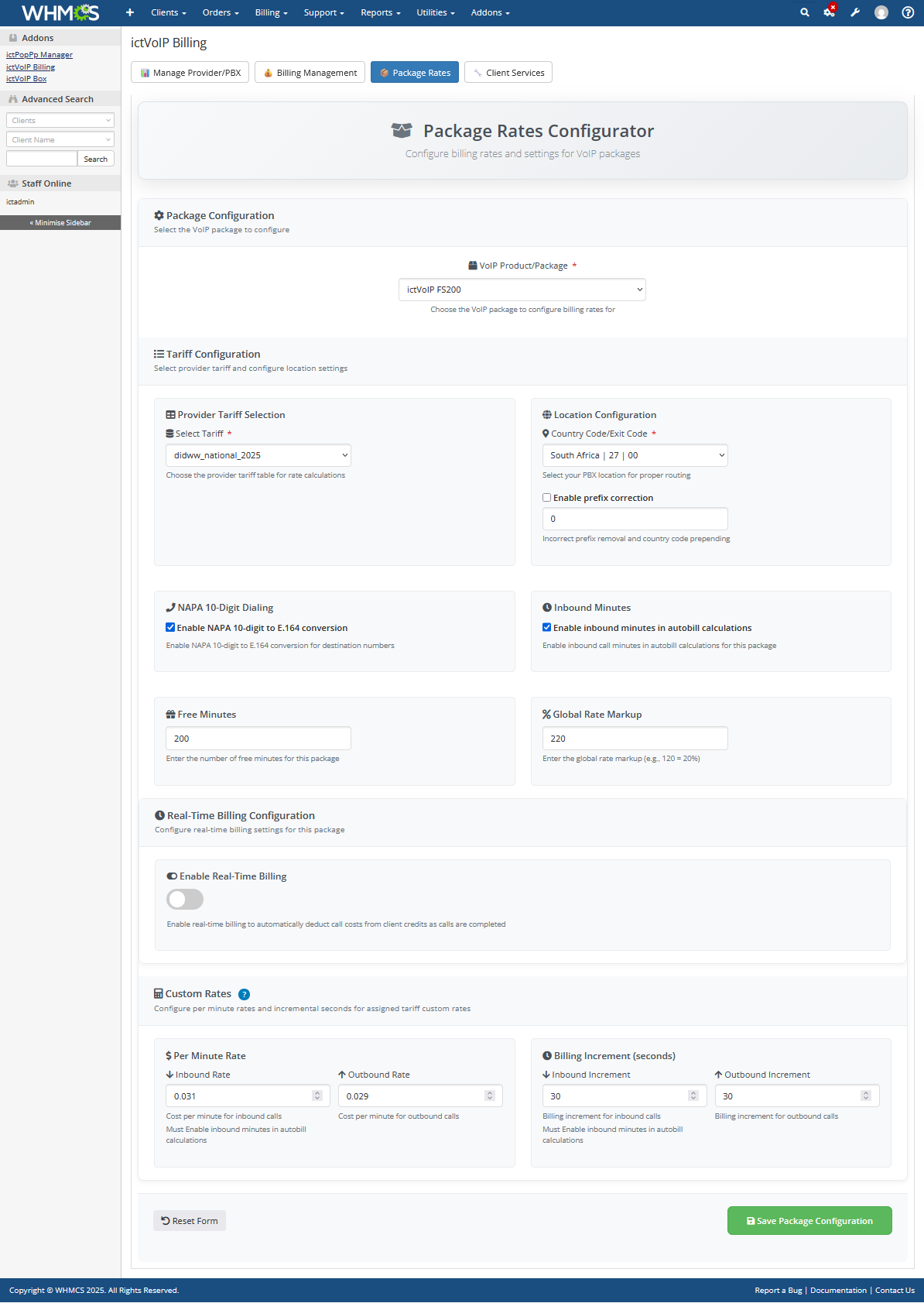
Overview
VoIP packages define the service offerings available to your clients. Each package can include specific rates, features, and billing structures tailored to different market segments and client needs.
Key Features:
Configurable Options:
Flexible package configuration
Custom rate structures
Metered or unlimited options
Global markup management
Country-tariff specific pricing
Assign Realtime Billing
Enable or Disbale Billing for Inbound Calls
Enable NAPA 10-digit to E.164 conversion
Enable prefix correction
PBX Location Configuration
Package Configuration
Step 1: Select VoIP Package
Navigate to ictVoIP Billing → Packages and select or create a new VoIP package.
Step 2: Assign Tariff/Rate Card
Link the package to a specific tariff or rate card:
Package: Premium VoIP Service
Tariff: telnyx_outbound_2025_06
Provider: FusionPBX - Telnyx - Global
Step 3: Configure Country Settings
Select the country where your PBX resides. This affects: * National call billing * International call routing * Exit code processing * Local number formatting
Step 4: Country Code Configuration
Configure country code settings for proper CDR processing:

Country Code Options:
E.164 Format - Standard international format (recommended)
Local Prefix - Local dialing without country code
Custom Format - Specific formatting requirements
Example Configuration:
For London, England setup: * Enable Local Prefix: Checked * Country Code: 44 * Local Calls: Use 0 prefix (e.g., 020 for London) * International Calls: Use 00 prefix
Note
We recommend adjusting your dial plan to produce proper E.164 destination_number format for optimal CDR processing.
Step 5: Global Markup Configuration
Set your global markup percentage:
Base Rate: $0.01 per minute
Global Markup: 25%
Final Rate: $0.0125 per minute
Step 6: Free Minutes Allocation
Configure free minutes for metered packages:
Package Type: Metered
Free Minutes: 1000
Overage Rate: $0.02 per minute

Package Type: Unlimited
Free Minutes: 0 (unlimited)
Overage Rate: N/A
FusionPBX Real-Time Billing
FusionPBX real-time billing processes call detail records (CDRs) directly from the FusionPBX environment and applies usage charges automatically as calls are completed.
This mode is designed for environments where you want near real-time usage processing instead of periodic batch invoicing.
Key characteristics:
Direct CDR access using the FusionPBX server module CDR integration
Separate CDR storage in mod_ictvoipbilling_fusionpbx_cdrs
Prevents duplicate processing by tracking unique call records
Audit trail of activation/deactivation events in mod_ictvoipbilling_realtime_stamp
Note
Real-time billing must be enabled per package. Services on packages with real-time billing enabled should not be billed by standard batch usage processing to avoid double billing.
Enable Real-Time Billing per Package
Navigate to Addons → ictVoIP Billing → Package Rates
Select the package you want to configure
In the real-time billing section, enable Real-Time Billing
Configure usage-related options as needed (free minutes, markups, incremental billing, inbound billing)
Save the package configuration
Cron Processing
Real-time billing is executed by running the FusionPBX server module realtimebilling.php script on a schedule.
Typical schedules run every 5 minutes:
*/5 * * * * /usr/bin/php /path/to/whmcs/modules/servers/fusionpbx/realtimebilling.php?runfrom=cron
Automatic Package Change Detection
If an administrator changes a service’s package in WHMCS, certain admin-side package changes may not trigger the standard lifecycle hooks. The real-time billing cron includes an automatic consistency check to keep real-time billing state aligned with the service’s current package configuration:
If a service is moved to a package with real-time billing enabled, the system will automatically activate real-time billing for that service on the next cron run.
If a service is moved off a package with real-time billing enabled, the system will automatically deactivate real-time billing for that service on the next cron run.
Monitoring & Troubleshooting
To verify real-time billing is working:
Confirm the cron is running successfully
Check that new rows appear in mod_ictvoipbilling_fusionpbx_cdrs after calls complete
Verify billing/credit events in WHMCS logs (for example, credit log entries associated with usage deductions)
Common issues:
No CDRs retrieved: verify FusionPBX connectivity/credentials and ensure the CDR integration library is present in the server module.
Billing not applied: confirm the package has real-time billing enabled and the service is on that package.
Duplicate CDRs: investigate uniqueness/duplicate prevention and confirm the CDR table is not being repopulated by another process.
Custom Rate Configuration
Custom Rate Options:
Create specialized rate structures for specific needs:

Custom Rate Examples:
Country-Specific Package: * Destination: Poland * Free Minutes: 1000 * Overage Rate: $0.05 per minute * Base Package: 1000 minutes included
Flat Rate Package: * All Calls: $0.03 per minute * Free Minutes: 0 * Override Provider Rates: Yes
Tiered Rate Package: * 0-500 minutes: $0.02 per minute * 501-1000 minutes: $0.015 per minute * 1000+ minutes: $0.01 per minute
Custom Rate Setup:
To enable custom rates, modify the tariff database:
-- Update tariff status to enable custom rates
UPDATE mod_ictvoipbilling_tariff_[provider_name]_[date]
SET status = 0
WHERE prefix = '[target_prefix]';
Database Location:
Custom rates are stored in the WHMCS database: * Database: ictvoip_dev6733 * Table: mod_ictvoipbilling_tariff_[provider]_[date] * Example: mod_ictvoipbilling_tariff_telnyx_outbound_2024_10
Package Types
Metered Packages:
Usage-based billing - Pay per minute
Free minute allocation - Included minutes
Overage rates - Additional minute pricing
Usage tracking - Real-time usage monitoring
Unlimited Packages:
Unlimited calling - No minute limits
Fixed monthly rate - Predictable pricing
Feature-based billing - Additional features
Fair use policies - Usage guidelines
Hybrid Packages:
Combined approach - Mix of metered and unlimited
Feature tiers - Different feature levels
Flexible billing - Multiple billing options
Custom limits - Specific usage limits
Rate Management
Rate Calculation:
The system calculates rates using the following formula:
Final Rate = (Base Rate + Custom Rate) × (1 + Global Markup %)

Example:
Base Rate: $0.01
Custom Rate: $0.005
Global Markup: 25%
Final Rate: ($0.01 + $0.005) × 1.25 = $0.01875
Rate Priority:
Custom Rates - Highest priority
Package Rates - Medium priority
Provider Rates - Base priority
Global Markup - Applied to all tariff rates but does not apply to Custom Rates
Rate Validation:
Verify rate accuracy
Check for conflicts
Validate markup calculations
Test rate application
Best Practices
Package Design:
Clear naming - Descriptive package names
Competitive pricing - Market-appropriate rates
Feature differentiation - Unique value propositions
Scalable structure - Growth-friendly design
Rate Configuration:
Consistent markup - Standard markup policies
Regular reviews - Periodic rate updates
Market monitoring - Competitive rate analysis
Client feedback - Rate optimization
Technical Setup:
E.164 formatting - Standard number format
Proper country codes - Accurate geographic settings
CDR optimization - Efficient call processing
Database maintenance - Regular cleanup
Extension detection - Inbound calls routed to local extensions are recognized as valid and not flagged for E.164 issues
Note
The CDR E.164 Validator now recognizes inbound calls to local extensions as valid, and does not flag inbound caller IDs from outside the product country as ‘Wrong Country’. Review your CDR validation results after package configuration to ensure all settings are correct. See the updated validator documentation and screenshots for details.
Troubleshooting
Common Issues:
Rate Calculation Errors - Check markup and custom rate settings
CDR Processing Issues - Verify country code configuration
Package Assignment Problems - Check provider and tariff linking
Billing Inconsistencies - Review rate priority and calculations
Debug Steps:
Verify package configuration
Check tariff assignments
Review country code settings
Test rate calculations
Monitor CDR processing
Support Information:
For package-related issues, provide: * Package configuration details * Rate structure information * Error messages and logs * Expected vs actual results
Next Steps
After package configuration:
Client Assignment - Assign packages to clients
Billing Setup - Configure automated billing
Usage Monitoring - Set up usage tracking
Performance Testing - Verify package functionality
Latest Package Rates UI & Functionality Updates
Tariff and Country Code Assignment
Each package can be linked to a specific provider tariff table. The Package Rates UI allows you to:
Select the provider tariff for outbound/inbound calls
Set the country code and prefix for number formatting
Enable or disable country code enforcement and prefixing
Enable special handling for North American 10-digit numbers (NAPA)
Enable tracking and billing of inbound minutes separately
Markup, Free Minutes, and Incremental Billing
The UI allows you to set: * Global rate markup (percentage applied to all rates) * Free minutes allocation (for metered packages) * Incremental cost and rounding for both inbound and outbound calls
Note: Global rate markup is bypassed when using custom rates.
These settings are saved per package and affect how rates are calculated and billed.
UI Improvements
When editing a package, all current settings (tariff, country code, markups, free minutes, etc.) are pre-populated in the UI for easy review and update.
Figure: The updated Package Rates UI with new controls for tariff assignment, country code, markups, and more.