Billing Management
CDR Processing & Billing Configuration
The Billing Management dashboard provides comprehensive tools for managing CDR processing, rate configuration, filtering, and automated billing processes. This central hub controls all aspects of the billing system.
Overview
The Billing Management system is where you prepare and control how ictVoIP Billing turns raw CDRs into billable usage. In a typical v1.4.0 deployment you will:
Import and maintain tariffs that define per-destination rates.
Configure packages that link tariffs to WHMCS products and include any free minutes or custom rules.
Apply CDR filters so internal calls, test numbers, or emergency calls are handled correctly.
Use Autobill to process CDRs and hand the resulting charges to WHMCS for invoicing.
This page focuses on tariffs, packages, filters, and the built-in Autobill debug view. For the CRON execution and runtime details of the Autobill scripts themselves, see Automated Billing (Autobill).
Key Features: * CDR processing and filtering * Rate management and export * Automated billing configuration * Debug and testing tools * Comprehensive filtering options
Tariff Management
Tariff Importing
Import provider rate cards and configure pricing structures. For detailed information, see: Tariffs
Tariff Exporting
Export existing tariffs to CSV format for review or modification:
Select the tariff name from the dashboard
Click Export to download the CSV file
Review and modify rates as needed
Re-import the updated tariff
Warning
When re-importing exported tariffs, do not include the “status” column in your CSV file.
Package Management
Package Configuration
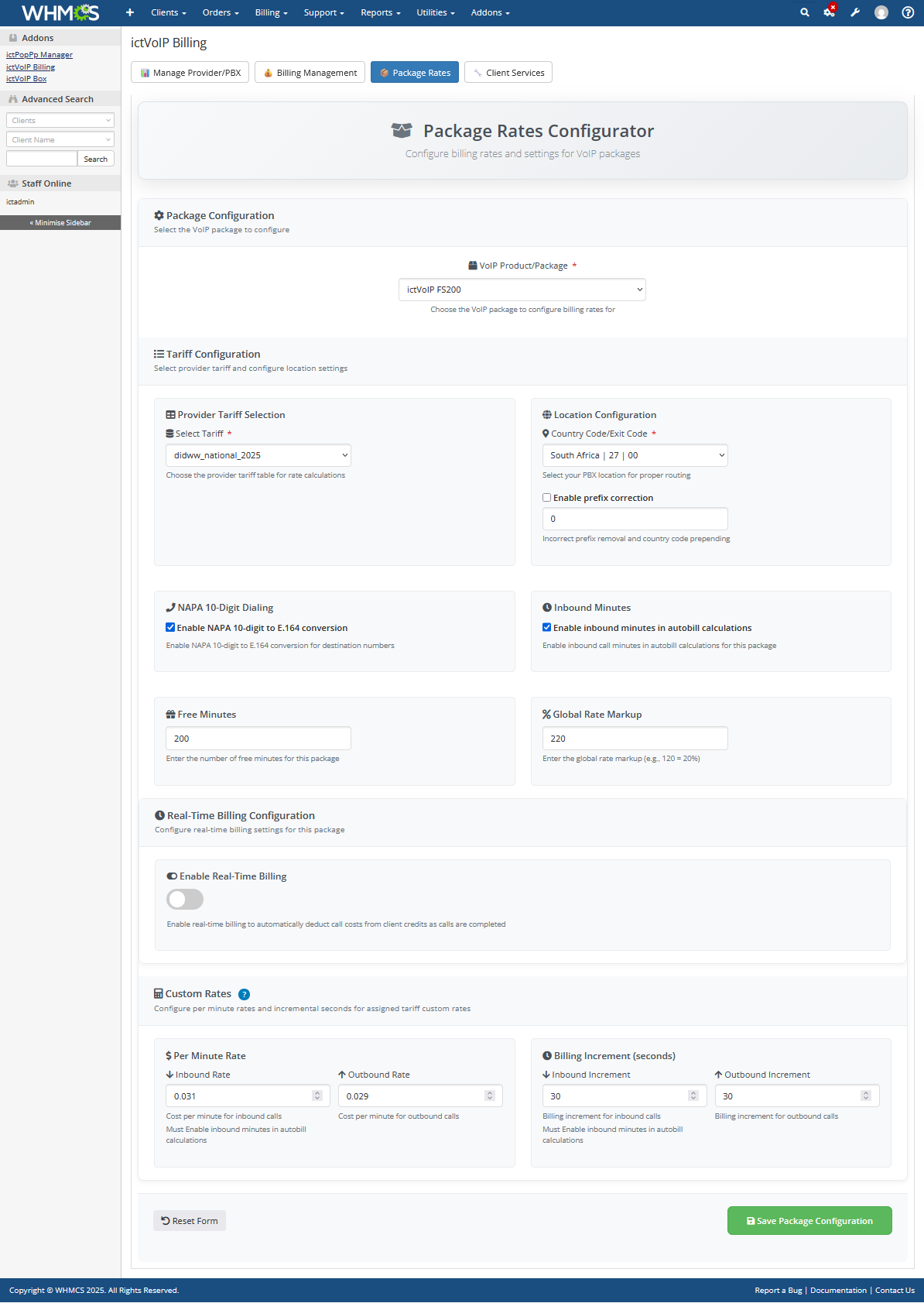
Configure VoIP service packages with specific rates and features. For detailed information, see: Package Rates
Package Features: * Rate structure configuration * Free minute allocation * Custom rate application * Global markup management
Autobill Debug
Debug Configuration
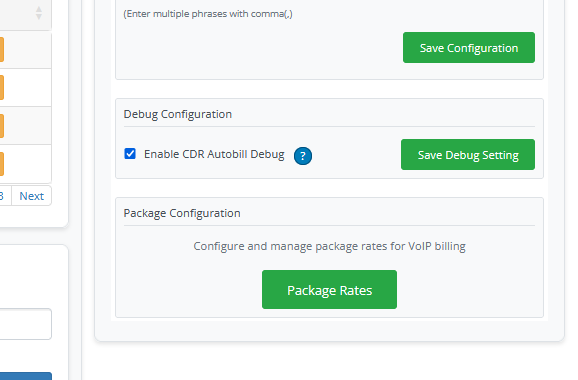
The CDR Autobill Debug settings on this page control the addon’s built-in debug view for CDR processing. Use this to test and monitor how billing rules are applied before enabling fully automated runs.
Debug Process:
Enable Debug Mode - Activate debug logging
Set Test Date - Configure client’s next due date to current date
Run Manual Test - Execute autobill process manually
Review Output - Analyze billing calculations and results
Debug Output:
The debug process displays detailed information including: * CDR processing results * Rate calculations * Billing summaries * Error messages and warnings
Warning
When running CRON via browser, processing can be very slow. Please be patient during execution.
Manual Testing:
Test your installation by accessing the autobill script directly in your browser:
URL: https://your-domain.com/modules/addons/ictvoipbilling/crons/autobill.php
Method: GET or POST
Authentication: Required
For detailed CRON configuration, see: Autobill CRON
CDR Filtering
Filter Configuration
Configure CDR filtering to exclude or suppress specific call types and destinations. Filtering is applied per provider and affects both billing and display.
Filter Types:
Exclude/Suppress - Remove CDR records from billing and display
Exclude from Billing - Remove from billing but keep in display
Custom Filters - Specific filtering rules
Exclude/Suppress Filtering
Purpose: * Exclude - Remove filtered CDR records from billing * Suppress - Hide CDR records from client view
Common Exclusions:
Internal System Calls: Exclude internal PBX system calls and features:
Filter Pattern: *xx,#xx,4443,4747,201,202,203,999,555

Examples:
*97 - Voicemail access
*71 - Call forwarding
*72 - Call forwarding activation
#72 - Call forwarding deactivation
4443 - System announcements
4747 - System features
Extension Calls: Exclude direct extension-to-extension calls within the same tenant:
Filter Pattern: 201,202,203,204,205

This excludes calls between extensions 201-205 from billing
System Features: Exclude PBX system features and announcements:
Filter Pattern: 999,555,4443,4747

Examples:
999 - Emergency system
555 - Test numbers
4443 - System announcements
4747 - Feature codes
Exclude from Billing
Purpose: Remove specific calls from billing while keeping them visible in CDR reports.
Toll Free Numbers:
Exclude North American toll-free numbers from billing:
Filter Pattern: 844xxxxxxx,888xxxxxxx,877xxxxxxx,866xxxxxxx,800xxxxxxx,1800xxxxxxx,1844xxxxxxx,1866xxxxxxx,1877xxxxxxx,1888xxxxxxx

Examples:
1-800-555-1234
1-888-555-5678
1-877-555-9012
Emergency Numbers:
Exclude emergency service numbers:
Filter Pattern: 911,112,999,000

Examples:
911 - North American emergency
112 - European emergency
999 - UK emergency
000 - Australian emergency
Local Services:
Exclude local service numbers and features:
Filter Pattern: [local],[inbound]

Examples:
Local DID numbers
Inbound call records
Voicemail access
Ring group calls
Custom Exclusions:
Create custom exclusion patterns for specific needs:
Filter Pattern: 2264763054,8884163054,18884163054

This excludes specific numbers from billing
Filter Configuration Best Practices
Pattern Design:
Use Wildcards - xxxxxxx for variable digits
Include Variations - Account for different formats
Test Patterns - Verify filter accuracy
Document Rules - Maintain filter documentation
Common Patterns:
# Toll Free Numbers
8xx,1-8xx,1-800,1-888,1-877,1-866

# Emergency Numbers
911,112,999,000,119,110

# System Features
*xx,#xx,4443,4747

# Local Services
[local],[inbound],[voicemail]
Testing Filters:
Enable Debug Mode - Activate detailed logging
Run Test CDRs - Process sample call records
Review Results - Verify filter accuracy
Adjust Patterns - Refine filter rules
Vendor Compatibility:
Note
Filter patterns depend on each vendor’s PBX CDR output format. While we maintain consistency across platforms, test filters before applying to production.
CDR Column Dependencies:
Filters are applied to specific CDR columns: * Direction - Call direction (inbound/outbound) * Description - Call description or feature * Destination - Called number * Source - Calling number
Troubleshooting
Common Filter Issues:
Over-filtering - Too many calls excluded
Under-filtering - Unwanted calls still billed
Pattern Errors - Incorrect filter syntax
Vendor Differences - PBX-specific formatting
Debug Steps:
Review CDR Output - Check raw CDR data
Test Filter Patterns - Verify pattern matching
Check Column Values - Confirm column content
Monitor Billing Results - Review billing output
Support Information:
For filtering issues, provide: * CDR sample data * Filter patterns used * Expected vs actual results * PBX vendor and version
Next Steps
After configuring billing management:
Test Configuration - Run debug tests
Monitor Results - Review billing output
Adjust Filters - Refine filtering rules
Production Deployment - Enable automated billing